
-
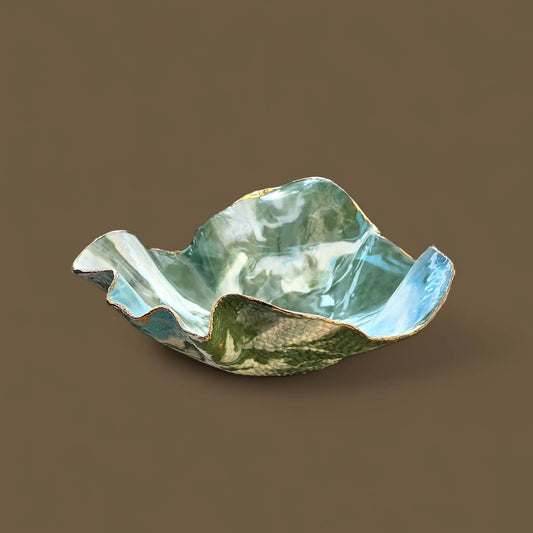
Decorative Ceramic Plate Large Leaf
Regular price 80,00 PLNRegular price -
Porcelain shell decorated with gold
Regular price 190,00 PLNRegular price


Ceramic art – original ceramic sculptures and lamps
Ceramic art combines natural materials, handmade craftsmanship, and the artist's original vision. Our offer includes unique ceramic sculptures and lamps that serve decorative, artistic functions, and in the case of lamps, also practical use.
Each object is made from high-quality clay and crafted by hand. Its final character is determined not only by its shape and proportions but also by the firing method, type of glaze, texture, and the effects created during work with fire and metal oxides. This ensures that each piece retains its own unique appearance.
Original artistic ceramics for interiors
Artistic ceramics allow for introducing objects into an interior that are not merely an addition to a ready-made arrangement. A handmade sculpture or lamp can become its central element, emphasizing the character of the space and building an individual atmosphere in the room.
Each work is the result of a combination of:
- original design,
- hand-forming clay,
- experience in working with the material,
- appropriately selected firing technique,
- individual surface finishing method.
Natural variations in texture, color, or glaze pattern are not defects. They are part of the creative process and ensure that no two pieces are entirely identical.
Ceramic sculptures
Ceramic sculptures are made from high-quality clay designed for firing at temperatures around 1250°C. They can retain the natural color of the material or be finished with ceramic glazes, raku technique, metal oxides, or alternative firing methods.
The inspiration for their creation comes from both organic forms and the human figure. The works include, among others:
- shells and spiral structures,
- stones,
- fragments of wood,
- nature-inspired surfaces,
- female and male heads,
- torsos,
- abstract interpretations of the human silhouette.
Each sculpture is the result of the artist's original vision and direct work with clay. Traces of modeling, surface irregularities, and differences in glaze distribution emphasize the handmade nature of the piece.
Ceramic sculpture as interior decoration
A sculpture can serve as a striking focal point in an arrangement or a more subtle detail. It looks good, among other places:
- on a dresser,
- on a console table,
- on a side table,
- on a bookshelf,
- on a separate shelf,
- in a specially lit niche.
Its perception changes depending on the viewing angle and the direction of light. Shadows emphasize depressions, convexities, and surface texture, allowing the object to look different at various times of the day.
Ceramic lamps
Ceramic lamps combine the functionality of lighting with the form of a decorative object. Their bases are made of clay, which, after firing, becomes durable ceramics. This allows the lamp to be both a light source and an element of applied art.
The lamp bodies are based on simple geometric forms or softer, organic shapes. They can remain in the natural color of the clay or be covered with ceramic glaze.
Depending on the model, the surface may be complemented by:
- glazes with varying degrees of sheen,
- matte finishes,
- effects of alternative firings,
- discolorations obtained using metal oxides,
- gold elements,
- decorative irregularities and textures.
The effects created during firing cannot always be faithfully replicated. Therefore, even lamps belonging to the same series may differ in color arrangement, details, and surface character.
A lamp with a sculptural character
The ceramic base remains decorative even when the lamp is switched off. When the light is on, the glaze reflections, indentations, matte sections, and form irregularities become more visible.
A ceramic lamp can look good on:
- a side table,
- a dresser,
- a console table,
- a desk,
- a bedside table,
- a bookshelf or low cabinet.
Detailed information regarding electrical equipment, lampshade, and dimensions should be checked in the description of the selected model.
Sculpture or ceramic lamp – which to choose?
| Feature | Ceramic sculpture | Ceramic lamp |
| Main function | Artistic and decorative | Practical, artistic, and decorative |
| Form character | Figurative, organic, geometric, or abstract | Geometric, organic, or sculptural |
| Most common inspirations | Nature, human, structures, and emotions | Geometry, nature, light, and spatial form |
| Finish | Natural clay, glazes, raku, metal oxides, alternative firings | Natural clay, glazes, alternative firing effects, and gold elements |
| Display location | Dresser, bookshelf, console table, shelf, or side table | Side table, dresser, desk, console table, or bedside table |
| Impact on arrangement | Creates an artistic focal point in the interior | Combines decoration with an additional light source |
| Repeatability | Each piece has individual characteristics | Each base may differ in surface and details |
A sculpture will be the appropriate choice when the artistic and decorative function is paramount. A lamp, on the other hand, will work well where an original form is to be combined with practical lighting.
How are ceramic objects created?
The creation process begins with selecting the right clay and developing the form. The material is hand-shaped, then gradually dried. This stage requires time, as too rapid moisture removal could lead to cracks or deformations.
After drying, the object goes into a ceramic kiln. Sculptures are fired at a temperature of about 1250°C. High temperature stabilizes the form and transforms the clay into a durable ceramic body.
Depending on the chosen technique, the work may then be glazed or subjected to further finishing processes. The final result depends, among other things, on the type of clay, temperature, firing atmosphere, glaze composition, and reactions occurring on the surface.
Techniques and finishing methods for ceramics
Natural clay color
Leaving the natural surface exposes the material's color, traces of hand-forming, and the raw character of the mass. This finish effectively highlights organic and minimalist forms.
Glazing
Ceramic glaze can impart color, sheen, matte finish, depth, and additional texture to the surface. Depending on the composition and application method, it is possible to achieve both uniform surfaces and more complex effects.
Raku
Raku is a technique that allows for characteristic crackles, discolorations, and effects resulting from the contact of heated ceramics with reducing materials. Some results occur spontaneously, which means each piece can look different.
Alternative firings
Alternative firings allow for experimentation with fire, smoke, firing atmosphere, and natural materials. The resulting discolorations and traces of the process become an integral part of the object.
Metal oxides and specialized glazes
Metal oxides and specialized glazes enable the creation of varied colors, reflections, tonal transitions, and irregular surfaces. The effect depends on many factors, so it cannot always be precisely predicted.
Gold elements
Gold details can highlight a part of the form, create contrast with natural clay, or complement a glazed surface. Sparingly used, they become a distinctive decorative accent.
Why is each piece unique?
The uniqueness of ceramics stems not only from the original design but also from the production process itself. The final appearance of the object is influenced by:
- the method of hand-forming,
- the properties of the specific batch of clay,
- the drying rate,
- the thickness and application method of the glaze,
- the object's placement in the kiln,
- the firing atmosphere and temperature,
- the reactions of metal oxides,
- the final detailing.
Even with a similar shape, it's impossible to achieve two completely identical surfaces. Each piece retains its own arrangement of colors, textures, and firing marks.
How to choose ceramic art for an interior?
When choosing a sculpture or lamp, it's worth considering not only its color but also its scale, texture, and the amount of available space.
A large sculpture works well as a standalone accent on a console table or dresser. Smaller forms can be combined with books, prints, wood, stone, or other natural materials.
A ceramic lamp, on the other hand, can create intimate lighting and simultaneously complement the furniture composition. Its base does not need to exactly match the interior colors. It can act as a contrast and attract attention with a distinctive texture or irregular glaze.
When choosing, it's worth paying attention to:
- the object's proportions in relation to the furniture,
- the direction of natural light,
- the color of the wall and surroundings,
- the presence of other decorations,
- the amount of free space around the piece,
- the place from which it will be most frequently viewed.
Why choose original ceramics?
Original ceramic art is created at a different pace than mass-produced decorations. Each piece requires concept development, hand-forming, drying, firing, and finishing.
Its value stems from:
- individual design,
- handmade craftsmanship,
- use of high-quality materials,
- knowledge of ceramic techniques,
- time required for creation,
- uniqueness of each piece,
- combination of craftsmanship and art.
Ceramic sculptures and lamps can become a permanent element of an interior, and their perception changes with light, surroundings, and display method.
Frequently Asked Questions
What is ceramic art?
Ceramic art uses clay and the firing process to create original spatial forms. These can be sculptures and decorative objects, as well as functional items with an artistic character, such as ceramic lamps.
Is each piece unique?
Yes. Hand-forming, glaze application, and the firing process mean that individual pieces differ in texture, color, and details. Even objects from the same series are not identical copies.
At what temperature are ceramic sculptures fired?
Sculptures are made from clay intended for firing at temperatures around 1250°C. The exact process is chosen to suit the type of material and intended finish.
What techniques are used to finish the works?
Techniques used include ceramic glazes, raku, alternative firings, metal oxides, specialized glazes, and gold elements. Some objects retain the natural color of the clay.
Are ceramic lamps handmade?
Yes. The ceramic bases of the lamps are hand-formed from clay, then dried, fired, and finished according to the design of a given model.
Do lamps also serve a decorative function?
Yes. The lamp base has a sculptural character and remains a decoration even when the light is off. When the light is on, it further emphasizes the structure and surface finish.
Where is the best place to display a ceramic sculpture?
A sculpture can be displayed on a dresser, console table, bookshelf, shelf, or side table. It is best to leave sufficient free space around it and ensure lighting that accentuates its form.
Can two pieces from the same series differ?
Yes. There may be differences in glaze pattern, shade, texture, and surface details. This is a natural result of manual craftsmanship and the firing process.